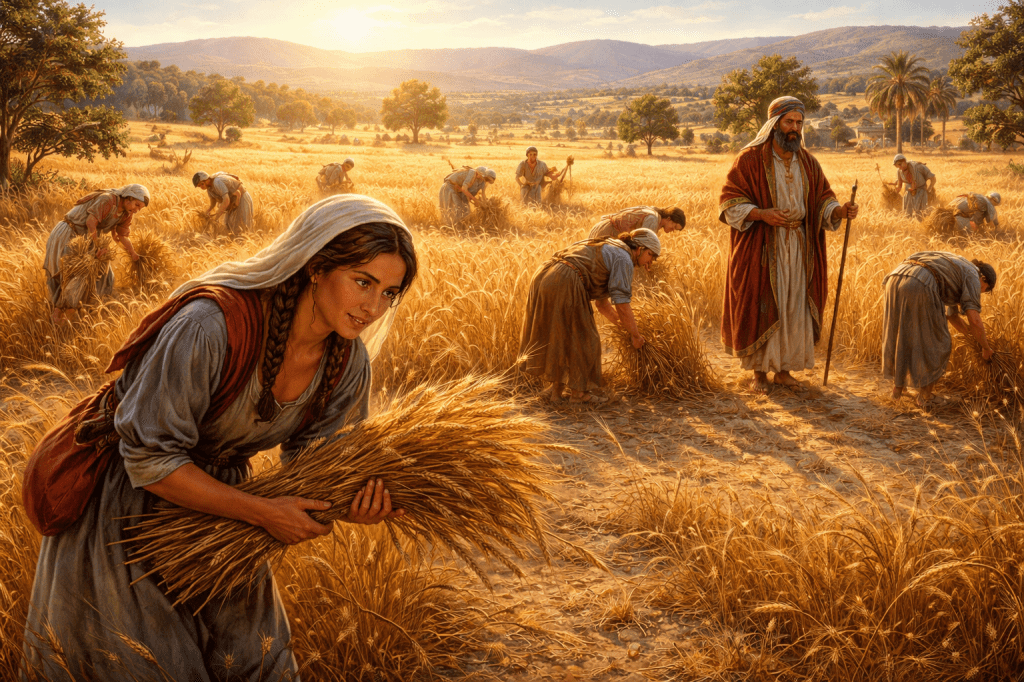
We all know Ruth for her famous line, “Where you go, I will go…” Her seven-fold declaration in Ruth 1:16-17 has become a hallmark of loyalty and commitment, appearing on posters, quotes, bookmarks and even in love notes. Likewise, we’ve been taught how the book of Ruth fits into the big picture of God’s redemptive plan. The story begins during the dark period of the Judges and ends with the genealogy of King David, ultimately leading to the coming of Jesus Christ, the Messiah. Because of this, we typically find the book of Ruth placed between Judges and 1 Samuel.
Recently, though, I learned that at some point in history, the book was positioned near Proverbs. This was due to its connection with the “excellent woman” described in Proverbs 31. While Proverbs 31 presents a portrait of such a woman, Ruth embodied and lived it out (Ruth 3:9). And as a woman myself, I can’t help but be drawn to her.
🌾
Counting the Cost (Earthly VS Eternal Perspective)
Ruth’s well-known declaration in Ruth 1:16–17 traces back to a moment when Naomi urged both Orpah and Ruth to return—to their country, their people, and their gods. For Naomi, returning to Judah was not merely geographical. It was a return to Yahweh — a step toward spiritual restoration. She knew this meant completely turning away from Moab and its idolatries. Because of this, Naomi could not promise them a good life in Judah.
At that point, Orpah and Ruth were faced with a decision:
“Nothing with Jehovah in Judah versus everything without Jehovah in Moab” (Ruth 1:11–13), a tension that remains familiar to every follower of Christ even today.Understanding the situation,
Orpah. Chose. Moab. (Ruth 1:14)
Her decision to return to what was safe and familiar was reasonable from an earthly perspective. In Moab, she would be with her people and could potentially remarry. She could rebuild her life and recover from her loss.
But Ruth chose differently.
She clung to Naomi and chose Judah. She was fully aware of what awaited her: widowhood, childlessness, and poverty. Ruth counted the cost. And so she declared: “Where you go, I will go… Your people shall be my people, and your God, my God…”
Ruth was resolved to remain loyal not only to Naomi, but to Yahweh. Regardless of the cost.
Yet beyond human determination, we see God’s sovereign hand at work. When we allow God’s Word to transform our minds and view our circumstances through the lens of faith, we open ourselves to being used for His greater purposes. Who would have thought that by choosing the uncertainties of Judah over the comforts of Moab, Ruth would be part of David’s royal lineage, and ultimately, of Jesus Christ, the Messiah (Matthew 1:5)?
🌾
Courage & Humility
Ruth is often known for her loyalty, commitment, and diligence (Ruth 2:7, 17). But what stood out to me in this study was how all of these were grounded in courage and humility.
Despite being urged to return multiple times, despite the uncertain future in Judah, and despite seeing Orpah return to Moab, Ruth clung to Naomi. And she persevered (Ruth 1:14–18). No amount of convincing made her think otherwise. No level of difficulty caused her to retreat. More than loyalty to Naomi, Ruth had come to recognize her need for Yahweh and had resolved to follow Him wholeheartedly.
Next, Ruth did not passively wait for provision. She acted.
She rose, took initiative, and worked (Ruth 2:2). Though she was a foreigner, a Moabitess, vulnerable to discrimination and hardship, she did not allow fear to paralyze her. Instead, she chose responsibility. She labored so that both she and Naomi could eat. Her mindset was not self-preserving but self-giving: to serve, not to be served; to consider Naomi’s needs above her own (Philippians 2:3–4). And in God’s providence, she was led to the fields of Boaz, where she found favor and protection (Ruth 2:3)
Even in the midst of that favor, Ruth remained humble. She understood her position as a foreigner and a servant. She gleaned behind the reapers, following the provisions of Leviticus 19:9–10 where she gathered what was left behind, even when it meant long hours of labor. Boaz’s kindness did not inflate her sense of entitlement. Instead, she received it as undeserved favor and continued faithfully in her work (Ruth 2:8–17).
Later, knowing Boaz was a kinsman-redeemer, Ruth followed Naomi’s instruction and approached Boaz at the threshing floor (Ruth 3:1–6). This required both courage and humility. A young woman approaching a man at night risked misunderstanding. Yet Ruth remained teachable, trusting Naomi’s guidance.
When the moment came, she spoke boldly, appealing to Boaz’s role within the law (Ruth 3:8–9). Her actions were not driven by emotion nor personal desire, but by love, obedience, and a willingness to act within God’s design. And Boaz affirmed, calling her “a woman of excellence.”
The book of Joshua shows us courage and humility in warfare — trusting God’s instructions to bring down the walls of Jericho (Joshua 6:16). In contrast, the book of Ruth shows us courage and humility in the quiet, ordinary moments of life through obedience, perseverance, and trust in God’s providence.
There are things worth clinging to and risks worth taking for the glory of God. When we step forward in faith amid uncertainty, while humbly entrusting our lives to Him, we are given the privilege of knowing Christ and becoming more like Him in the process.
And regardless of the outcome, we can rest in the assurance that He is working all things together for our good and for His purposes (Romans 8:28).
🌾
My gleanings have focused much on Ruth. But beyond her admirable character, we see the sovereign God who orchestrates famine, loss, grief and even romance for the fulfillment of His purposes.
The story of Ruth reminds us that even in the darkest seasons, God remains in control, faithfully weaving every detail according to His will. And we are invited to surrender fully to Him.
At one point, I considered writing about Boaz’s exemplary character but I chose instead to keep my focus on Christ, the One who already gave us the perfect example of love.
The book of Ruth continues to speak to me in different seasons of my life. And I trust that each time I return to it, there will be new truths to glean.
 Gleanings of Grace
Leave a comment