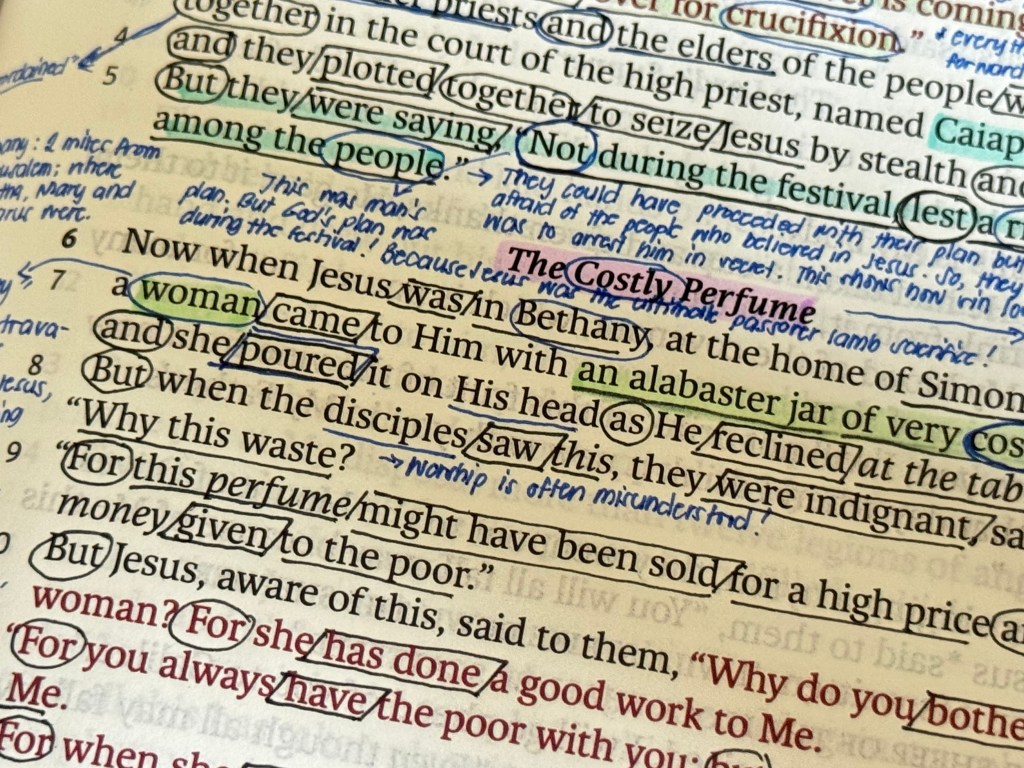
6 Now when Jesus was in Bethany, at the home of Simon the leper, 7 a woman came to Him with an alabaster jar of very costly perfume, and she poured it on His head as He reclined at the table. 8 But when the disciples saw this, they were indignant, saying, “Why this waste? 9 For this perfume might have been sold for a high price and the money given to the poor.” 10 But Jesus, aware of this, said to them, “Why do you bother the woman? For she has done a good work to Me. 11 For you always have the poor with you; but you do not always have Me. 12 For when she poured this perfume on My body, she did it to prepare Me for burial. 13 Truly I say to you, wherever this gospel is proclaimed in the whole world, what this woman has done will also be spoken of in memory of her.
🌾
A few Sundays ago, our senior pastor (Pastor Bob Amigo of Higher Rock Christian Church) preached on Matthew 26:6-13 — The Costly Perfume. He carefully walked us through the passage, highlighting how Mary boldly and sacrificially worshipped Jesus.
As I sat at the front scribbling notes in my LSB Bible, God’s Word pierced deeply into my heart through the preaching. One phrased stayed with me for weeks,
“Own your Ministry. Be broken and spilled out!”
These words were further impressed upon me during our cell meetings, where we watched a film about Amy Carmichael and sang the song Broken and Spilled Out.
Because of this, I revisited the passage during my personal devotions and felt led to write down my gleanings from that memorable sermon. I’m also looking forward to beginning a new series where I share my gleanings from the Lord’s Day preachings.
🌾
Mary, A Plain Village Woman
The Gospel of Matthew simply described her as a woman with an alabaster jar of very costly perfume (Matthew 26:7). Yet in the Gospel of John, she is identified as Mary, the sister of Martha and Lazarus (John 12:1–11), from the humble village of Bethany.
This was the same Mary who chose to sit at Jesus’ feet while Martha was distracted with much serving (Luke 10:41–42). Mary desired above all to listen to her Lord, and Jesus commended her for choosing the good part. She was also the same Mary who quickly arose and fell before Jesus in grief, upon the death of Lazarus (John 11: 29-32).
Some scholars infer that she may have been the youngest among the siblings. As a woman in her time, Mary held no public status, title, nor prominence.
Yet Scripture remembers her.
I have always understood and embraced God’s design for men and women. I submit to His wisdom regarding male headship in the church, trusting that His design is both good and for His glory. In the same way, I have come to appreciate how marriage uniquely reflects Christ and the Church through loving leadership and willing submission.
Still, as a single woman, I wrestled with a question in my own heart:
“Is there truly a place for single women to be all out for God’s kingdom?”
🌾
Costly Worship
“…and she poured it on His head as He reclined at the table.”
The Book of Matthew describes it as an alabaster jar of very costly perfume (Matthew 26:7). While the account of John gives further detail, calling it a litra of pure nard—extremely precious in value (John 12:3). During the preaching, Pastor Bob explained that the perfume was worth around 300 denarii, roughly equivalent to a year’s wage for a common laborer.
For someone like Mary, this was no small offering.
“But when the disciples saw this, they were indignant saying, ‘Why this waste? For this perfume might have been sold for a high price and the money given to the poor.”
John’s Gospel identifies this as Judas Iscariot—the disciple who would later betray Jesus for thirty pieces of silver (Matthew 26:15), an amount worth far less than what Mary willingly poured out before her Lord.
Truly, our hearts are often revealed by what we’re willing—or unwilling—to give.
As Pastor Bob said during the sermon, “Worship is often misunderstood.”
Women at that time were expected to serve quietly in the background. For Mary to step forward and pour the perfume on Jesus was unconventional and undignified in societal standards. Yet she did it anyway—holding nothing back and filling the house with the fragrance of her worship
Years ago, this passage moved me to pour out nearly all my savings to attend a convention in Israel, convinced that God was calling me there.
Now, years later, I hear this passage again in an entirely different season of my life—a season marked by prayerful discernment, stillness, and singleness.
And so, I find myself asking,
“What is my alabaster jar of costly perfume?“
“What else can I offer to the Lord Jesus Christ?“
“Am I willing to obey even when it goes against social expectations?”
At this point, I have come to realize that time is my most valuable currency. More than possessions or experiences, the greatest offering I can lay before Him is my very life—denying myself, taking up my cross, and following Him in wholehearted worship.
That my life, too, would become a pleasing aroma before my King.
🌾
Jesus, The Object of Our Worship
“But Jesus, aware of this said to them, ‘Why do you bother the woman? For she has done a good work to Me.’”
What others misunderstood, Jesus fully understood.
He knew that Mary’s act was one of costly worship, preparing Him for burial. Christ was fully aware of His impending death and the purpose for which He had come. The hour appointed by the Father had arrived—the hour in which the Son would be glorified through suffering and sacrifice.
Having sat at Jesus’ feet and listened closely to His teaching, Mary must have grasped this truth: that Jesus was the Messiah, the Son of God, the Lamb who would be slain for sinners like her.
And so, out of faith and love for Christ, she poured out her costly perfume before Him.
What others rejected, Jesus received.
🌾
“Truly… wherever this Gospel is proclaimed in the whole world, what this woman has done will also be spoken in memory of her.”
Mary held no public status. No title, nor prominence. She was simply a plain village woman who worshipped Jesus with all that she had—not merely through a costly perfume, but through her wholehearted devotion.
And so, I return to the question I once wrestled with:
“Is there truly a place for single women to be all out for God’s kingdom?”
Scripture answers with a resounding yes.
And Mary’s life stands as one testimony among many.
May my life be the same—broken and spilled out for Christ.
 Gleanings of Grace
Leave a comment