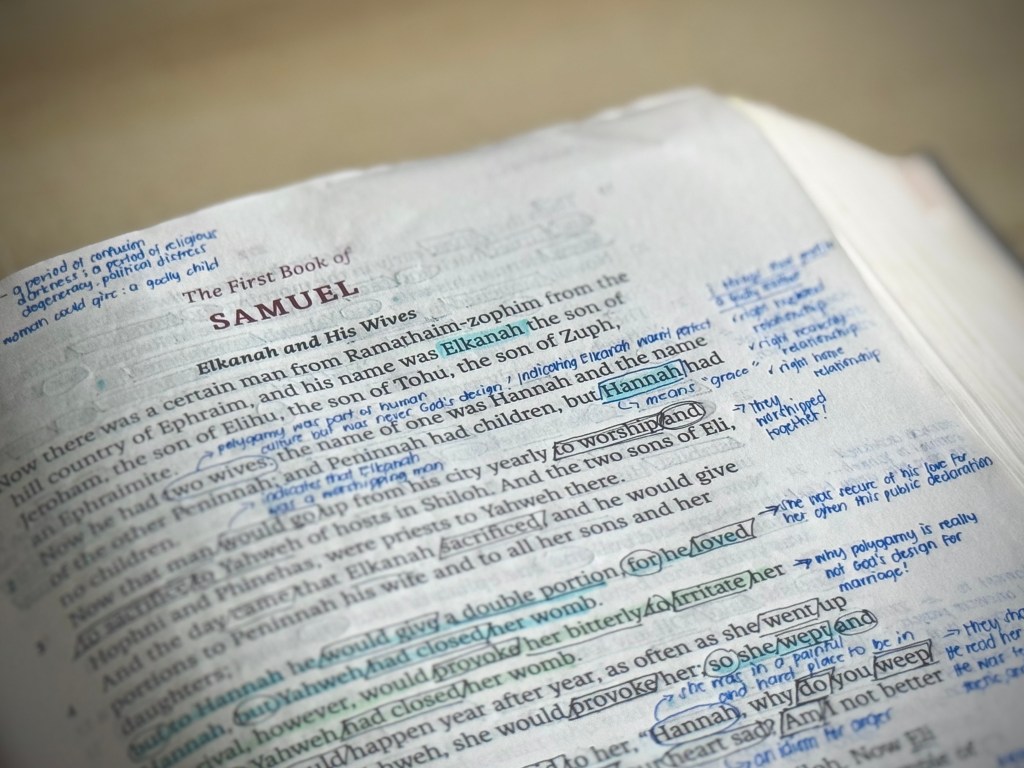
Every year in my Bible plan, I always look forward to the story of David in the books of Samuel—from being a young shepherd, to becoming a valiant warrior, and eventually ascending the throne as king of Israel. God’s sovereignty and faithfulness to David have encouraged me through different seasons of life.
This year though, I did not expect to resonate deeply with Hannah—particularly her faith in Yahweh amid affliction and unanswered prayers. I complemented my study with John MacArthur’s Grace to You podcast series, Hannah: A Godly Mother, and I’ve been gleaning so much from her story.
🌾
So, who was Hannah?
Hannah was one of Elkanah’s wives. Yup, you read that right. Elkanah had two wives—Hannah and Peninah. They lived during the time of the Judges, when “everyone did what was right in their own eyes.” While polygamy was prevalent in their culture, it was never God’s design for marriage.
Elkanah loved Hannah,
But Hannah was barren.
As Scripture says, “Yahweh had closed her womb.” And yet, “children are a gift of the Lord, the fruit of the womb is a reward” (Psalm 127:3). Hannah’s barreness became her affliction. Worse, Peninah provoked her year after year to bitterness. Peninah was fruitful while Hannah remained childless for years.
🌾
Hannah’s Genuineness
Hannah entrusted herself to God’s providence even while grieving deeply. She acknowledged reality and did not pretend her pain away. Neither did she dismiss her desires in apathy. When provoked, she did not retaliate. Instead, she wept and would not eat (1 Samuel 1:6-7).
Elkanah knew she was troubled. He understood she was carrying deep sorrow. And so, Hannah ran to Yahweh in her distress. She poured out her bitter soul before Him and continually brought her complaint to God—year after year.
Hannah did not have to pretend she was fine.
This struck me deeply.
I have prayers that have remained unanswered for years now. These are sincere prayers flowing from a desire to glorify God. Yet over time, disappointment can disguise itself as surrender. I can easily reason: “It’s okay. God is sovereign. I already prayed about it. I’ll just leave it to Him.” And while that may sound spiritual, I’ve come to realize something uncomfortable:
It’s one thing to genuinely surrender.
It’s another thing to become passive.
The line between surrender and passivity becomes difficult to discern when self-protection is involved—when I no longer want to hope deeply enough to be hurt.
And so I’m left asking: “Amid all my unanswered prayers, am I genuinely surrendered to God? Or has disappointment slowly made my heart passive and guarded?”
🌾
Hannah’s Confidence
After pouring her heart out before the Lord in Shiloh, Hannah “went her way and ate, and her face was no longer sad” (1 Samuel 1:18).
Her circumstances had not changed yet.
Her prayer for a child was still unanswered.
But something within her had shifted.
Hannah understood she could cast her burdens upon the Lord. As John MacArthur said, “Hannah was a woman of patient faith.” Her confidence ultimately rested in Yahweh—not merely in receiving the child she longed for.
In the tension of waiting, I’ve come to hold fast to these promises: that I can present my prayers to God and allow His peace to guard my heart and mind (Philippians 4:6–7); that our Heavenly Father gives good gifts to His children (Matthew 7:11); and that He is working all things for my good and for His glory through what He gives and what He withholds (Romans 8:28).
The power behind prayer is not found in the intensity of my desires nor in the strength of my perseverance, but in God Himself—enabling me to rejoice always, pray without ceasing, and give thanks in every circumstance (1 Thessalonians 5:16–18).
And so, I can pray with a surrendered heart.
I can trust that even when my prayers are not answered as hoped, drawing near to God is never wasted.
This leads me to ask: “Would I still trust God even if my prayers are not answered the way I desire? Is my confidence truly in God—or in having my desires fulfilled?”
🌾
Hannah’s Commitment
In his podcast, John MacArthur described Hannah as a “woman who had passion for God’s best.”
Hannah vowed that if the Lord gave her a son, she would dedicate him to Yahweh all the days of his life (1 Samuel 1:11). At first, Hannah’s vow sounded to me as though she was bargaining with God. But as the story unfolds, her vow reveals something deeper. Hannah understood that even the child she longed for ultimately belonged to Yahweh.
In due time, God answered Hannah’s prayer, and she named her son Samuel (1 Samuel 1:20). Then, Hannah fulfilled her vow. After weaning the child, she brought Samuel to Shiloh along with sacrificial offerings and dedicated him to the Lord for lifelong service (1 Samuel 1:24–28).
Hannah was a woman marked by commitment—to Yahweh, to her word, and to faithfully steward the child entrusted to her. Her longing for a son was not merely rooted in personal fulfillment, social status, or future security. Ultimately, her desire was yielded back to God.
And Samuel—Hannah’s long-awaited child—would eventually become instrumental in establishing Israel’s kingship and paving the way for the coming of the Messiah according to God’s redemptive purposes.
This reminds me that even answered prayers are to be held loosely before God.
This leads me to ask: “Are my prayers shaped primarily by self-interest? Or by a sincere desire for God’s kingdom and glory?”
🌾
The story of Hannah deeply encourages me. It reminds me that God is at work even through affliction, waiting, and unanswered prayers.
Her tears had purpose.
Her waiting was not wasted.
And perhaps that is one of the deeper lessons hidden within Hannah’s story: prayer is not merely about receiving what I long for, but about drawing near to Yahweh Himself.
And He remains worthy—both in His answers and in His silence.
 Gleanings of Grace
Leave a comment