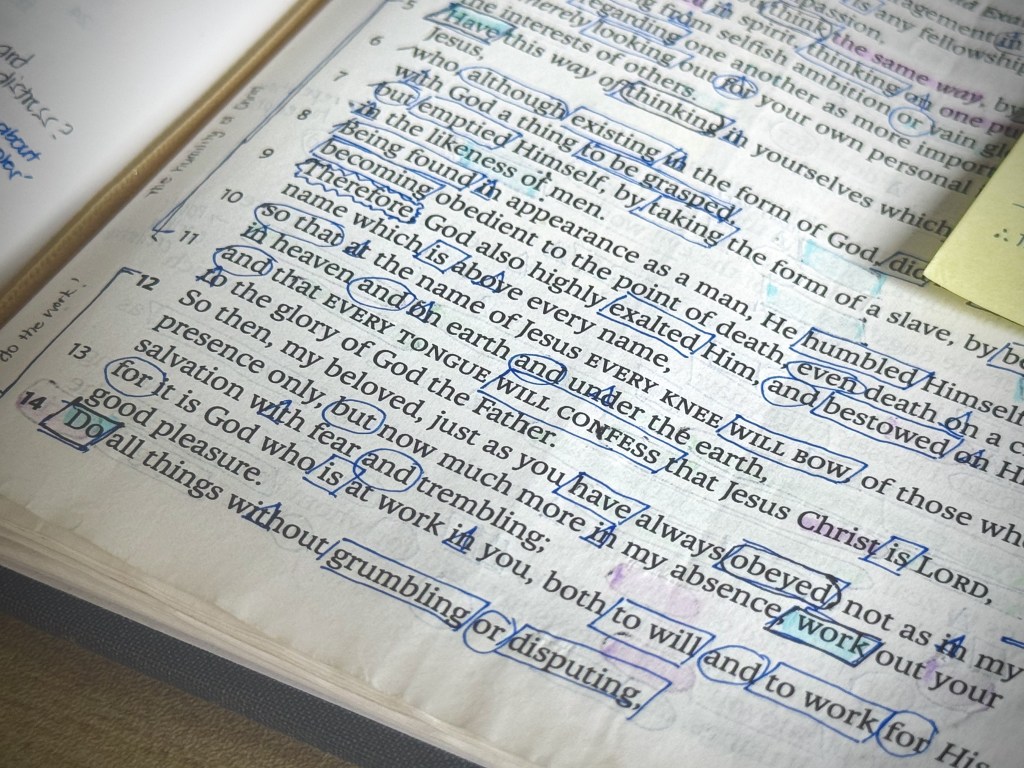
12 So then, my beloved, just as you have always obeyed, not as in my presence only, but now much more in my absence, work out your salvation with fear and trembling; 13 for it is God who is at work in you, both to will and to work for His good pleasure. 14 Do all things without grumbling or disputing, 15 so that you will be blameless and innocent, children of God without blemish in the midst of a crooked and perverse generation, among whom you shine as lights in the world, 16 holding fast the word of life, so that in the day of Christ I will have reason to boast because I did not run in vain nor labor in vain. 17 But even if I am being poured out as a drink offering upon the sacrifice and service of your faith, I rejoice and share my joy with you all. 18 And you also, rejoice in the same way and share your joy with me.
Having pointed believers to the humility of Christ, Paul calls them to live out the Gospel, especially in his absence.
🌾
Work Out Your Salvation
Here, Paul is not telling believers to earn salvation. Rather, he is calling them to actively pursue the fruit of salvation in their lives.
The Greek word for “work out” (κατεργάζομαι katergázomai) carries the idea of work that yields results. Meanwhile, The two words, “fear” (φόβος phóbos) and “trembling” (τρόμος trómos), speak of approaching this task with seriousness, humility, and an awareness of our inadequacy.
Being saved does not mean, “I’ll have it easy because I’m going to heaven anyway.” The work still continues even after being saved because sin still lingers, causing my best efforts to fall short. These words, “..work out your salvation with fear and trembling” are to sober me and to keep me vigilant at all times.
While my inadequacy ought to keep me from complacency, another reason to work out my salvation is knowing that God is continuously at work in me.
The Greek word for “work” here is ἐνεργέω (energéō). This is the same word Paul used in Ephesians 1:20 where he wrote “..which He worked in Christ by raisingHim from the dead and seating Him at His right hand in the heavenly places..” Its noun counterpart, ἐνέργεια (energea), is where the English word “energy” is derived from.
Hence, God supplies the power–and this is not just any power, but the same power that raised Christ from the dead–shaping my resolve and enabling me to work for His good pleasure.
This truth keeps me from two extremes. On one hand, my inadequacy ought to keep me from self-trust. On the other, God’s power keeps me from despair.
Because God is working, I can keep working.
“What habits am I building to work out my salvation with fear and trembling?”
“How does God’s work in me encourage me when I feel inadequate?”
🌾
Do All Things Without Grumbling or Disputing
Paul then turns to a very practical expression of obedience.
The word grumbling (γογγυσμός, gongysmós) refers to habitual complaining and discontentment. Disputing (διαλογισμός, dialogismós) carries the idea of skeptical reasoning and resistance.
Paul calls believers to put these away.
As a woman myself, I recall Peter’s exhortation in his first letter:
“But let it be the hidden person of the heart, with the incorruptible quality of a gentle (or lowly) and a quiet spirit, which is precious in the sight of God.” (1 Peter 3:3)
While he mainly addressed the wives here, I believe the principle still applies to every believer pursuing biblical womanhood.
To probe this further, being “gentle”or “lowly” (Greek: πραΰς praÿs) refers to meekness marked by self-restraint, while being “quiet” (Greek: ἡσύχιος hēsýchios) speaks of peacefulness that remains undisturbed even amid turbulence.
As I gleaned on this further, I couldn’t help but recall an encouragement from a good friend.
At one point, I knew God was convicting me through His Word to do something. Yet His providence seemed to indicate otherwise at that time. Amid the tension, my friend smiled and said:
“M, this is a time for sweet submission…”
I was baffled.
But through her patient words, I slowly realized that God was giving me an opportunity to be sanctified.
In that moment, meekness meant surrendering my need to be right. It meant humbly trusting that others might see things I could not see. And so, even when I wanted to act, I stepped back and entrusted the situation to God.
To my surprise, peace followed.
Not because I got what I wanted, but because I learned to trust the One who governs all things.
Another reason to put away grumbling and disputing is that believers are called to shine as lights before a dark generation.
Here, Paul presents a clear juxtaposition between the character of God’s children and the world around them.
“…to be blameless and innocent, children of God without blemish in the midst of a crooked and perverse generation, among whom you shine as lights in the world, holding fast the word of life..”
The Greek word for light, φωστήρ (phōstḗr), refers to something that gives light. This word is derived from φῶς (phōs).
Phōs is the word used in John 1:4-5:
“In Him was life, and the life was the Light of men. And the Light shines in the darkness and the darkness did not overtake it.”
This is the broadest Greek term for light or luminousness.
From this word study, we can infer that Phōs–the Word, Jesus Christ Himself–is the Source, while believers shine as phōstḗr–lights that bear witness to Him in the midst of a crooked and perverse generation.
As I reflected on this passage, one truth stood out to me:
Being a light does not always have to be loud. Sometimes, it looks like sweet submission in silence. Sometimes it looks like trusting God when His providence disappoints my expectations. It is cultivating a gentle and quiet spirit, knowing that even when done away from the eyes of people, it remains precious in God’s sight.
So day by day, I have to keep asking,
“How can I put off grumbling and disputing today?”
“What truths do I need to hold fast so I can trust God’s providence for me today?”
🌾
Being Poured Out
I initially thought this section would be straightforward. After all, Paul had already said, “To live is Christ.” Surely being “poured out” would just be another way of saying it, right? But as I reflected further, I realized there is something deeper here. I complemented this study with Joey Rigney’s article–Poured Out for Others from Desiring God.
The phrase “being poured out as a drink offering” is actually just one Greek word, σπένδω (spéndō).This word generally refers to ritual drink offerings. To me though, this word somehow reminds me of the English word, “spend”–though etymologically unrelated.
In this passage, spéndō is used figuratively to mean pouring out one’s blood in crushing death for God’s kingdom.
In his article, Rigney presented how Paul, in this passage, alluded to the Levitical system.
In the Old Testament, the Israelites offered sacrifices to Yahweh. The primary one was the whole burnt offering, also known as the ascension offering. These sacrifices formed part of God’s prescribed means for dealing with sin and maintaining covenant fellowship with Him.
With Christ’s completed work through His incarnation, death and resurrection, He became the perfect Lamb sacrificed for our sins once and for all (Hebrews 10:10).
Therefore, believers no longer offer sacrifices to become right with God. Instead, we are exhorted to present our bodies as a living sacrifice, holy and pleasing to God, which is our spiritual service of worship (Romans 12:1).
The word “sacrifice” (θυσία thysía) is the same word Paul used when referring to the Philippians’ sacrifice and service in verse 17. Paul is affirming that the Philippian believers, like all believers, are called to sacrificial service.
In Numbers 15, every ascension offering was accompanied by grain and drink offerings. Thus, Paul alludes to this when he said,
“But even if I am being poured out as a drink offering..”
In other words, as Philippians present themselves as living sacrifices before the holy God, Paul pours out his own life as the accompanying drink offering.
As Joey Rigney wrote:
“Each of us is called to be a drink offering for others. We’re called to be poured out as a glorifying accompaniment to their lives of sacrificial service.”
This made me stop.
It’s one thing to be poured out for God’s Kingdom.
It’s one thing to be poured out serving people.
But to be poured out so others can pour themselves out for God’s glory—
This is different.
How can a finite and limited being like me be spent, so others can pour themselves out for God’s glory?
I pray to find the answer one day.
🌾
To work out my salvation with fear and trembling.
To put away grumbling and disputing.
To be poured out so that others may faithfully pour themselves out for God’s glory.
All of these are possible because God Himself is at work in His people.
And because He is working, I can keep working.
This is my prayer for myself—and for every believer reading this.
 Gleanings of Grace
Leave a comment