In 2019, I was blessed to see the Old City of Jerusalem with my own eyes. On the same trip, we took a morning walk around the city and watched the sunrise at Mt. Olives. Then, we passed by the sight of Kidron Valley and walked our way inside the Garden of Gethsemane.
I can’t help but remember this trip as Pastor Bob walked us through our Matthew series thus far. From Jesus offering Himself as the final Passover Lamb in the upper room; to their dialogue with His disciples at Mt. Olives; passing by Kidron Valley; and then arriving at the Garden of Gethsemane.
Even before that trip, I’ve long heard of the “Garden of Gethsemane” from my old religion. “The Agony in the Garden” was one of the “mysteries” I recited in a prayer ritual I practiced since childhood. Even so, I never really understood the depth of the agony that took place in that garden.
Through the years, I thank God for continuously renewing my mind. And just last Sunday, we revisited the agony in the garden–not necessarily by going back to Jerusalem, but by finding its meaning in my life through the preaching of His Word.
The Garden of Gethsemane during Jesus’s time was a quiet place away from the bustling crowd. Now, it is a heritage site visited by tourists and pilgrims from across the globe. In that garden are olive trees that stood through generations, with its name translating as “oil press”–where olives are crushed for oil. This allegorically points to Jesus Christ as J.R. Miller said,
“Olive oil was very valuable. It was used chiefly for food and for lighting. The sufferings of Christ have yielded the highest blessings to the world. Food for men’s souls and light to shine in darkness.”
Just as olives were crushed to produce oil for man’s food and lighting; Jesus was crushed to death to feed us eternal hope and salvation, being our Light in a dark and hopeless world. And Jesus, knowing His imminent suffering at the cross, came to this very garden to pray.
As you go through my gleanings, I invite you to read Matthew 26:36-46.
🌾
Solitude
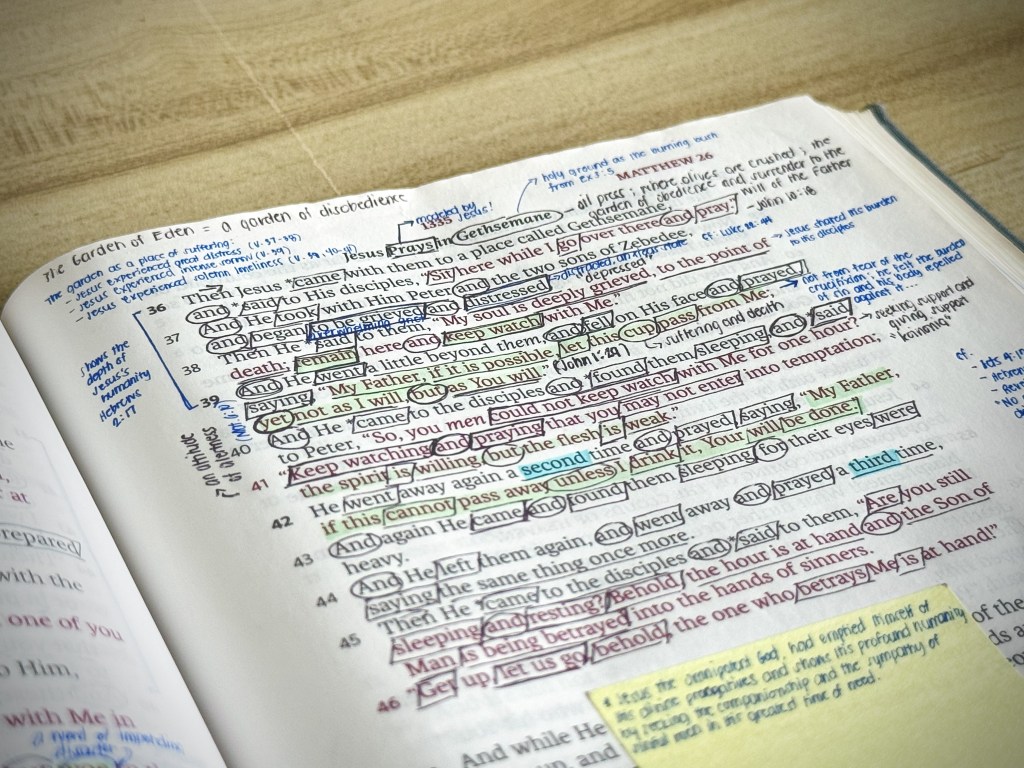
Jesus came to the garden with Peter, and with James and John, the two sons of Zebedee. As they arrived Jesus then said, “Sit here while I go over there and pray” (v. 36). Jesus intentionally drew away from them to pray alone. As I progressed through the passages, I saw how Jesus’ prayer all throughout was marked by a deep solitude that found meaning in being with the Father–even if it meant being alone.
This led me to ask, “Am I savouring my lone times with the Lord? Or do I hasten it so I can be around people? How comfortable am I in being alone with the Lord?”
🌾
Struggle
Jesus was deeply grieved and distressed to the point of death (v. 37-38). “Deeply grieved” or περίλυπος perílypos denotes a superlative sense of sadness implying full sorrow that suffocates; while “distressed” or ἀδημονέω adēmonéō expresses an intense anxious and depressive state that the mind could hardly grapple with. This gives me insight into Jesus’ humanity while He remained fully God. He knew profound sorrow and distress. He understood what it meant to suffer and to struggle under an overwhelming burden.
“Therefore, He had to be made like His brothers in all things, so that He might become a merciful and faithful high priest in things pertaining to God, to make propitiation for the sins of the people.” (Hebrews 2:17)
He did not fear suffering. Jesus felt the full weight of the sin He was about to bear, and in His perfect holiness He recoiled at the prospect of drinking the cup of divine wrath. And so, He said, “Father, if it is possible, let this cup pass from Me; yet not as I will, but as You will” (v. 39).
Before drawing away from them, Jesus asked his disciples “to remain and keep watch with Him.” But upon His return, He found them asleep. And He said, “Keep watching and praying that you may not enter into temptation; the spirit is willing but the flesh is weak” (v. 41).
A compelling reason for me to pray steadfastly is the conflict between the spirit and the flesh. These two continue to wage war within me throughout my lifetime. And this is a battle no believer is exempted from–not even ministers and pastors who have served God’s kingdom for significant years. Amid the battle, believers are called to “put on the full armor of God” (Ephesians 6:11, 13-17), and to pray in the Spirit at all times.. being alert with all perseverance (Ephesians 6:18) so we remain guarded against the cunning enemies of our souls–the devil, the world and the flesh.
“For our struggle is not against flesh and blood, but against the rulers, against the authorities, against the world forces of this darkness, against the spiritual forces of wickedness in the heavenly places.” (Ephesians 6:12)
It’s one thing to remain.
But to remain yet asleep is different.
Knowing I am no better than Peter, James, and John, by God’s grace, may I be found watchful and faithfully persevering in the struggle until the day of Christ’s return.
In light of this, “How am I staying watchful day by day? How does Christ’s return motivate me to stay vigilant and to persevere in prayer?”
🌾
Shared Burden
Then He said to them, “My soul is deeply grieved, to the point of death; remain here and keep watch with Me.” (v. 37-38)
Even Jesus–the sole perfect person who walked on earth–not only struggled with the reality of His impending suffering and death; but likewise felt compelled to share His burden with His imperfect disciples–showing His profound humanity.
And He came to the disciples and found them sleeping, and said to Peter, “So, you men could not keep watch with Me for one hour? (v. 40)
Though Jesus foreknew His disciples would fail Him, this did not stop Him from seeking their company amid His ordeal. This led me to ask, “How does the truth that I am just as imperfect as others change my perspective on seeking for people’s prayers?”
Reflecting on Jesus’ example, “How willing am I to be vulnerable with people?” There is discernment in trusting people at varying degrees. But “discernment” can also be disguised as deep-seated pride that refuses to be truly seen and known. Knowing Jesus was the most capable and yet, likewise, the most humble person who ever lived – how should this truth shape my “discernment” then?
On the other hand, “How reliable and trustworthy am I when people share their struggles with me? Do I keep them in steadfast prayer? Or do I judge them quietly–and worse, gossip about them?”
🌾
Surrender
He went away again a second time and prayed, saying, “My Father, if this cannot pass away unless I drink it, Your will be done.” (v. 42)
Jesus had to drink the cup of suffering ordained for Him. He may have wrestled with it but He always knew this was the only way when He said –“I am the way, and the truth, and the life. No one comes to the Father but through Me (John 14:6).
But while this may be so, Jesus was also fully God.
He had authority to lay down His life, and to take it up again (John 10:18). He had more than twelve legions of angels at His disposal (v. 53). Jesus wasn’t entirely helpless.
Jesus could have resisted. Yet He willingly submitted Himself to the Father’s will knowing it satisfied greater eternal purposes, even if that meant taking on the full wrath of God.
And as He fully yielded to the Father’s will, Jesus bore no grudge–even to His disciples who failed Him when He needed them most (v. 43-44).
Jesus perfectly exemplified what it means to surrender to the Father’s will.
Knowing this, “How should surrendering to God’s providence shape my perspective on difficulties and disappointments toward people?”
🌾
Strength
After praying in solitude for three times, with His disciples failing to keep watch with Him, Jesus came back saying, “Are you still sleeping and resting? Behold, the hour is at hand and the Son of Man is being betrayed into the hands of sinners. Get up, let us go; behold, the one who betrays Me is at hand!” (v. 45-46).
After wrestling in prayer and fully submitting Himself to the Father’s will, Jesus was strengthened to face the cross.
And so, in the next accounts, Jesus was then arrested, tortured and led to die a gruesome death at the cross. This was the cup of suffering He had to drink to redeem His people.
🌾
I’ve come to embrace this truth: It’s part of being human to struggle and to share our burdens. But strength is ultimately found in surrendering to the will of God even with our last strength and amid people failing us.
We all have our own gardens too.
A place where we come before God in solitude;
A place where we can be vulnerable with our struggles;
A place where we welcome trusted brethren to share our burdens with;
A place where we yield our wills in surrender;
And a place where we find strength.
Yet there is only one true Gethsemane;
Just as there is only one Christ and only one true Savior.
And because Christ fully yielded to the Father’s will by drinking the cup of wrath and rising again to glory;
“Therefore let us draw near with confidence to the throne of grace, so that we may receive mercy and find grace to help in time of need.” (Hebrews 4:16)
And so, our gardens may not be as famous as the Garden of Gethsemane. They may be ordinary places hidden from the eyes of others. Yet it is often in these quiet places of prayer, surrender, and dependence that God graciously meets His people.
 Gleanings of Grace
Leave a comment