“Do you love me?”
“Yes..”
How often do we ask these words from our loved ones? We seek their response hoping to be assured when they answer it with a resounding yes. But, is love all about words?
Jesus Himself would later ask Peter the same question.
Last Sunday, Pastor Bob Amigo opened his sermon with the beginning of Jesus’ “Via Dolorosa” or the “Way of Sorrows.” Before following Jesus further along the Via Dolorosa, Pastor Bob turned our attention to Peter.
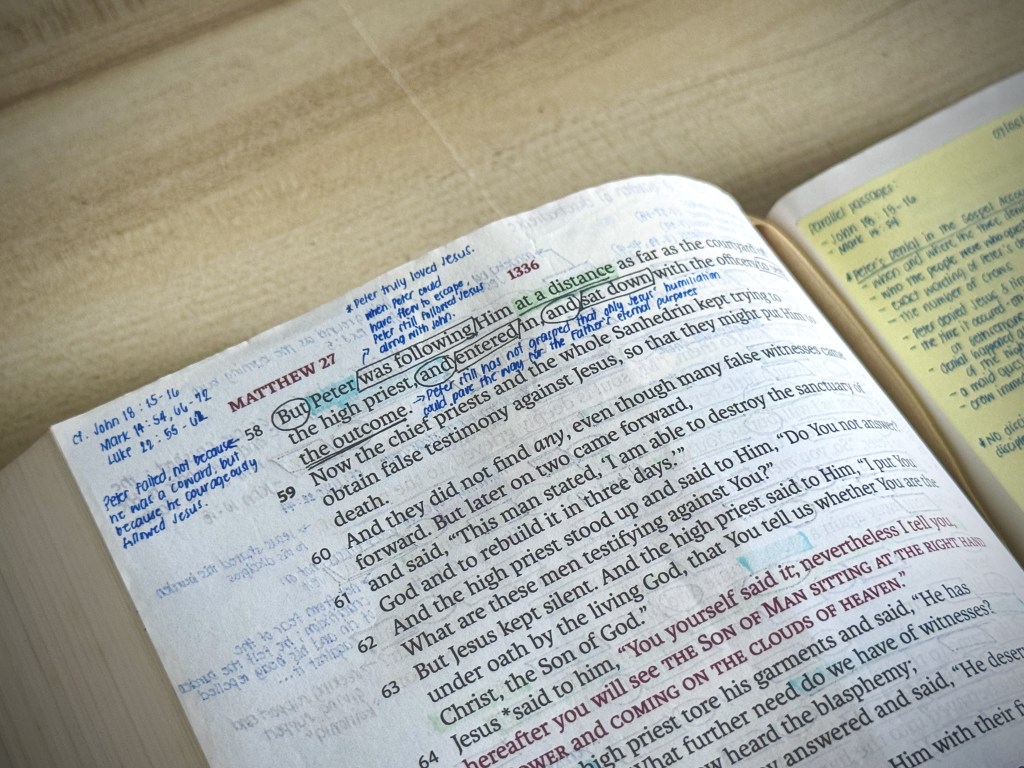
Then, Pastor Bob presented the common aspects recorded in the four Gospel accounts about Peter’s denial. And after doing my own reading, I’ve decided to use this as my outline.
As you read my gleanings, I invite you to read the following passages:
- Matthew 26:57–58, 69–75
- Mark 14:54, 66–72
- Luke 22:54–62
- John 18:15–18, 25–27
🌾
Who: Peter, The Apostle
Peter wasn’t just one of the twelve.
He was among Jesus’ closest circle who witnessed His transfiguration (Matthew 17:1–9, Mark 9:2–8, Luke 9:28–36); and who saw Jesus at His most vulnerable point at the Garden of Gethsemane (Matthew 26:46–56, Mark 14:32–42, Luke 22:39–46, John 18:1–2).
Even more importantly, he was handpicked by Jesus among all disciples to lead the church saying, “…you are Peter, and upon this rock I will build My church; and the gates of Hades will not overpower it” (Matthew 16:18).
Peter was a disciple characterized by zeal. His fervor was made manifest when he said:
- “Even though all may fall away, because of You, I will never fall away.” (Matthew 26:33)
- “Even if I have to die with You, I will not deny You.” (Matthew 26:35)
In his zeal, Peter drew out his sword as Jesus was being seized. And even when all the other disciples fled away to hide, Peter still followed Jesus–although from a distance.
🌾
Where: The Courtyard
Peter followed Jesus into the courtyard. The four Gospels all attest to this.
Jesus was led to face Caiaphas–the High Priest, the scribes, and the elders during their time. Although it was quite risky for him, Peter made his way into the courtyard to witness Jesus’ interrogation. Eager to know the outcome, he positioned himself near the fire as the night was getting cold. But little did he realize this would cause him a disadvantage.
As he drew closer to the firelight, some of the crowd began to recognize him.
🌾
What: Denying Jesus Three Times
Whether it was some servant-girl, a bystander or one of the high-priest’s slaves who recognized him; what’s common across all four Gospels was that Peter refused to acknowledge any connection with Jesus to the point of cursing.
This was Peter.
He was one of the twelve apostles.
He was of Jesus’ closest circle.
He was chosen to be the rock of the church.
And yet he denied Jesus,
Not just once–but three times.
As Pastor Bob shared, “There is nothing so bad that the best of us may not fall.”
How sobering could this be.
🌾
When: Before The Rooster’s Crow
As recorded in the four Gospels, the rooster’s crow immediately followed after Peter denied Jesus three times. Then he was brought to recall Jesus’ words to him, “…before a rooster crows, you will deny Me three times” (Matthew 26:34, Mark 14:30, Luke 22:34, John 13:38).
In utter despair, Peter walked away from the courtyard knowing he contradicted his own words: “Even if I have to die with You, I will not deny You” (Matthew 26:35).
Truly, Jesus’ words stand true regardless of human resolve.
🌾
Peter’s story, however, did not end in that courtyard. His greatest failure was not the final chapter of his life. The same disciple who denied Christ three times would later become one of His boldest witnesses.
Yet everything unfolded under God’s sovereign plan. No matter how bold, passionate, and sincere Peter was for Christ, it simply was not God’s appointed time.
Christ had not yet been glorified, and the Holy Spirit had not yet been poured out upon the disciples. Amid his boldness for Christ, Peter had not yet grasped that only Jesus’ humiliation and subsequent exaltation could pave the way for God’s redemptive purposes. All of humanity is sinful–not one is righteous. Only Jesus’ complete work–His life, death and resurrection–could redeem His people from the punishment of sin, which is eternal death.
After dying on the cross and lying in the tomb for three days, Jesus rose from the dead. He appeared to His disciples showing His victory over sin and death. Then, He told them these words:
“..And behold, I am sending the promise of My Father upon you, but you are to stay in the city until you are clothed with power from on high” (Luke 24:49).
Then at God’s appointed time, the Holy Spirit came powerfully upon the disciples, including Peter, on the day of Pentecost (Acts 2:1-4).
His mind was illumined;
His heart was emboldened.
After fully understanding the Gospel by the power of the Holy Spirit, Peter rose up boldly to preach Christ to a multitude of people (Acts 2:14–36). It was so powerful that when people heard this, their hearts were pierced (Acts 2:37).
So back to the question, “Do you love me?”
Peter once confidently declared his love for Christ, only to deny Him three times before dawn. Yet after the resurrection, Jesus did not ask Peter, “Why did you fail Me?” Instead, He asked, “Do you love Me?” Just as Peter denied Christ three times; Christ likewise asked him this question three times.
- 15 So when they had finished breakfast, Jesus said to Simon Peter, “Simon, son of John, do you love Me more than these?” He said to Him, “Yes, Lord; You know that I love You.” He said to him, “Tend My lambs.” (John 21:15)
- 16 He said to him again a second time, “Simon, son of John, do you love Me?” He said to Him, “Yes, Lord; You know that I love You.” He said to him, “Shepherd My sheep.” (John 21:16)
- 17 He said to him the third time, “Simon, son of John, do you love Me?” Peter was grieved because He said to him the third time, “Do you love Me?” And he said to Him, “Lord, You know all things; You know that I love You.” Jesus said to him, “Tend My sheep.. 19 …“Follow Me!” (John 21:17, 19c)
Despite having denied Jesus three times, Peter went on to become a bold witness of the risen Christ, just as Jesus had promised. He proved his love for Christ not merely with words, but with his very life.
There is so much to glean on how the Gospel was made real in Peter’s life. Through the grace of the Gospel, Peter was restored despite failing Jesus completely. Through the same Gospel, the Holy Spirit illuminated his mind to the truth of God and emboldened him to preach Christ against all odds.
Peter’s story teaches me that love for Christ is not ultimately proven by bold promises, but by a life continually restored and transformed through the Gospel.
The Gospel that restored Peter is the very same Gospel proclaimed today. It is not only my source of hope, but also the truth that illumines my mind and gives me the right zeal to joyfully do His will—wherever He calls me.
And so the invitation remains: “Repent and believe in Christ.”
 Gleanings of Grace
Leave a comment